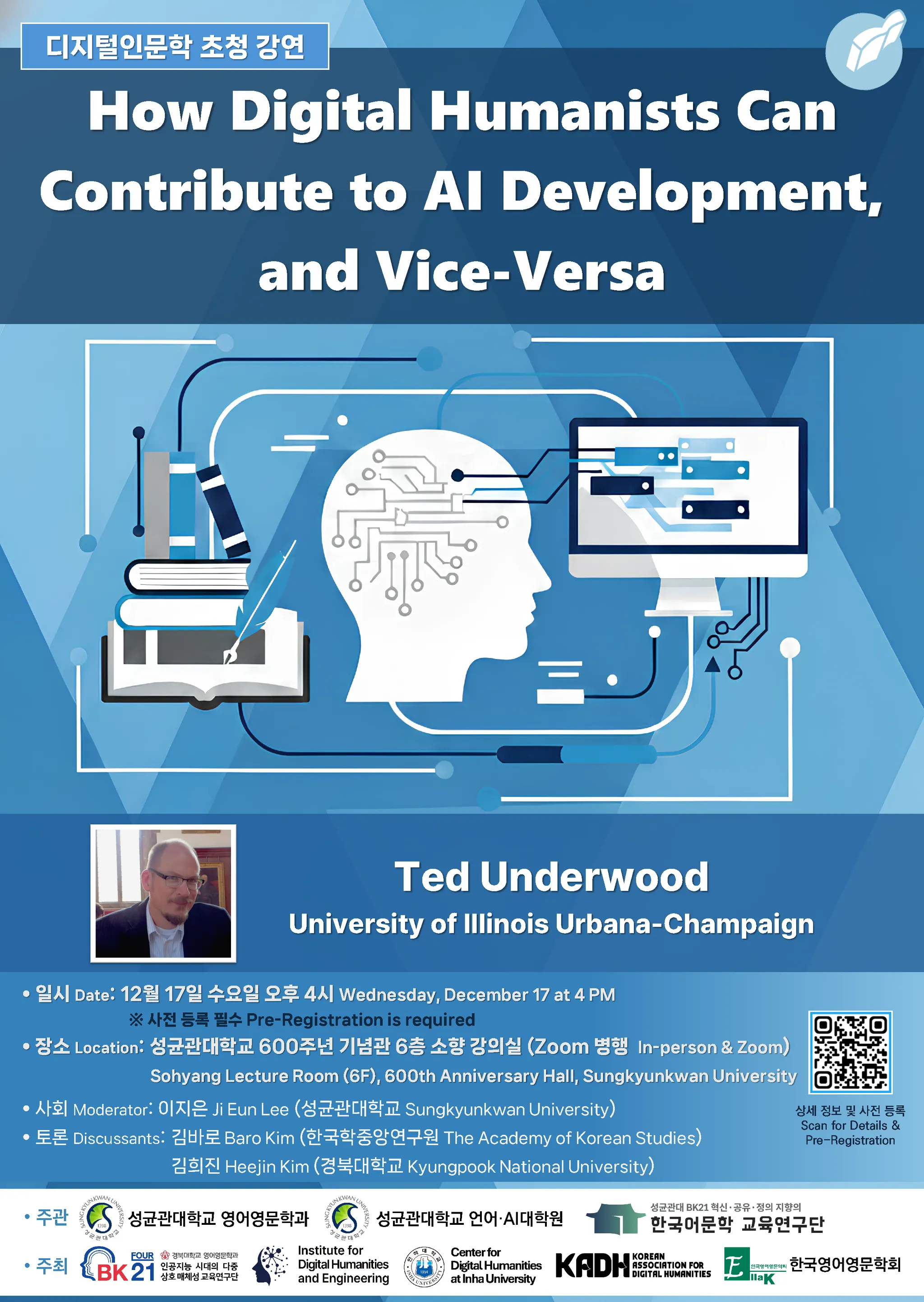
오는 12월 17일 수요일 오후 4시에는 디지털인문학의 창립자이자, 미국 언론에서 샘 앨드먼을 능가하는 AI현인이라고 칭송받는 UIUC 영어영문학과 Ted Underwood 교수님이 성균관대에 직접 오셔서 하시는 초청강연이 예정되어 있으니 많은 참여 바랍니다.
1. 강연자: Prof. Ted Underwood (University of Illinois Urbana-Champaign)
https://tedunderwood.com/ted-underwood/
2. 특강 주제: “How Digital Humanities Can Contribute to AI Development, and Vice-Versa”
3. 주관:
성균관대학교 영어영문학과, 성균관대학교 언어·AI대학원, 성균관대학교 국어국문학과 BK21 한국어문학 교육연구단
4. 주최
경북대학교 영어영문학과 BK21 교육연구단, 경북대학교 디지털인문공학연구소, 인하대학교 디지털인문학연구센터,한국디지털인문학회(KADH), 한국영어영문학회(ELLAK)
5. 일시 및 장소: 2025년 12월 17일 (수) 오후 4시~
성균관대학교 600주년 기념관 6층 소향강의실
6. 사전등록 필수!
https://forms.gle/e8zf2m4f9DSaUcHg8
7. 강연자에 대한 소개와 강연 내용
■ 강연자 소개
테드 언더우드는 일리노이 대학교 어바나-샴페인의 영어과, 정보과학과 교수이다. 그는 계산적, 통계적 방법을 통해 문학사를 탐구한다. 그의 방법론은 전통적인 비평 방식에서 디지털 도서관의 대규모 분석 방식으로 방향의 전환을 도모한다. 예를 들어, 선행 논문에서 언더우드는 탐정 소설이나 과학 소설 같은 장르가 시간에 따라 어떻게 결정화되었는지 추적했다. 또한 그는 1780년 경부터 문학적 인물 묘사에서 젠더에 대한 변화하는 가정들을 검토했다. 저서로 <태양의 작업: 문학, 과학, 정치경제학 1760-1860>, <문학사 시대 구분이 왜 중요했는가: 역사적 대비와 영문학 연구의 위상>, <먼 지평선: 디지털 증거와 문학적 변화>가 있다. 최근에는 생성형 AI가 문화사와 문학 분석에 미치는 영향을 탐구하고 있다.
Ted Underwood is a Professor of English and Information Sciences at the University of Illinois, Urbana-Champaign. His work explores literary history through computational and statistical methods, moving from traditional criticism of eighteenth- and nineteenth-century texts toward large-scale analysis of digital libraries. Underwood has traced how genres like detective fiction and science fiction crystallized over time and examined changing assumptions about gender in literary characterization from around 1780 onward. He is author of The Work of the Sun: Literature, Science, and Political Economy 1760-1860, Why Literary Periods Mattered: Historical Contrast and the Prestige of English Studies, and Distant Horizons: Digital Evidence and Literary Change. More recently he has been exploring the implications of generative AI for cultural history and literary analysis.
■ 강연 내용
디지털 인문학자들은 수십 년 동안 텍스트와 이미지를 이해하기 위해 머신 러닝을 사용해 왔다. 거대 언어 모델(LLM)을 우리 도구의 최신 진화판으로 상상하는 것은 자연스러운 일이다. 거대 언어 모델을 도구의 진화로 보는 관점은 타당하고, AI는 실제로 인문학자들이 과거를 조명하도록 도울 수 있다. 하지만 사회적 영향력에 관한 한, 우리가 AI를 돕는 것이 똑같이 중요할 수 있다. 현대 언어 모델은 여전히 상충하는 여러 관점에서 볼 수 있는 문제에 대해 추론하는 데 어려움을 겪는다. 인문학자들의 역사적 해석 경험은 바로 이 지점에서 구체적인 유용성을 가진다. 우리 인문학자들은 AI 연구자들이 해석적 과제를 정의하는 데 도움을 줄 수 있을지 모른다. 예를 들어, 특정 시간, 장소, 사회적 위치에 있는 사람처럼 추론하는 모델의 능력을 측정하는 벤치마크를 구축하는 방식이다. 이번 강연에서 문학 연구자, 사회학자, 컴퓨터 과학자들과 협력하여 최근 구축하기 시작한 크로노로직(ChronoLogic)이라는 벤치마크를 소개하고자 한다.
Digital humanists have been using machine learning to understand texts and images for several decades. So it would be natural to envision large language models (LLMs) as the latest evolution of our tools. And this is not wrong: AI can indeed help humanists cast light on the past.
But where social impact is concerned, it may be just as important for us to help AI. Contemporary language models still struggle to reason about questions that can be viewed from multiple conflicting perspectives. I’ll suggest that humanists’ experience of historical interpretation becomes concretely useful here. We are well positioned to help AI researchers define interpretive tasks—for instance, by building benchmarks that measure a model’s ability to reason like a person in a particular time, place, and social position. I’ll briefly describe ChronoLogic, a benchmark of this kind that I have recently begun to build in collaboration with literary scholars, sociologists, and computer scientists.
6. 문의 : 문과대학 영어영문학과 이지은 교수 (02-760-0261, jieunclee@skku.edu)
* 강연과 토론은 영어로 진행되며, 강연은 현장 참가자들에게 스크린으로 AI 자동번역을 제공할 예정입니다. Q&A는 사회자의 통역으로 진행됩니다.